X-Ray Technology in a Nutshell
The most common imaging technique used today is a radiograph (x-ray film) and the most common x-ray ordered is a chest x-ray, and the musculoskeletal x-ray exam comes in second. An x-ray provides a two dimensional image of the interior of the body and the procedure is performed by a Radiologic Technologist. A single x-ray passes through the body and exposes the film on a radiograph (or fluorescent screen) placed on the opposite side. Tissues having different densities show up as differing densities on the radiograph i.e. x-rays which have there nature of being absorbed to various degrees through body tissues depending on the density of them.
The Four Main Radiographic Densities
There are four fundamental radiographic densities. This is how they may appear on the fluorescent screen: Air and gases appear black or radiolucent. Fat appears gray to black. Muscles and water appear grey. Bones and calcium appear white, or radiopaque. A tissue that is more dense absorbs more x-rays than tissues that are less dense. Radiopaque is a very dense tissue and a less dense tissue is said to be radiolucent. Bone is very dense and fat is moderately dense while other tissues are least dense. It is important to differentiate between two types of densities that are physical density and radiographic densities. The radiographic density of a substance is related to it's physical density
CT Scan Technology (Computed Tomography)
In CT Scanning, x-rays moves in an arch around the part of the body being observed through a laser-like beam. The beams of x-rays passed through the region of the body imaged are collected by a special detector which converts the x-rays into electronic pulses that produce readings of the density of the tissue into a 1cm slice of the body. From these readings a computer can assemble a picture of the body called a CT Scan that can be viewed on a fluorescent screen, then photographed for later examinations. CT scan stands for computerized tomography. It obtains parts of the body that can't be seen on a standard x-ray with the help of computer algorithms in conjunction with the enhanced x-ray technology.
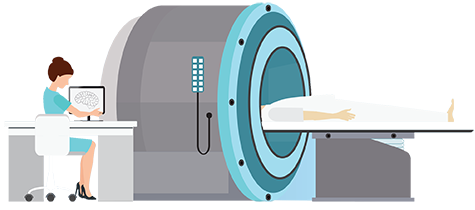
MRI Technology - Magnetic Resonance Imaging (X-Ray Vision without actual X-Ray's)
MRI uses the magnetic properties of the hydrogen nucleus, which is excited by radio frequency radiation transmitted by a coil surrounded by the body part. When placed in strong magnetic fields, the nuclei of certain atoms absorb radio frequencies beamed at them and then emit their own radio frequency waves. This process allows MRI Tech's and physicians to see very clear pictures of the inside of the body including tissues, organs, and blood vessels. MRI is a noninvasive technique that does not use ionizing radiation. MRI has become one of the primary tools used to image the brain, spinal cord, major blood vessels, and several key organs. The images can be produced in 3-D, which significantly enhances the physician's ability to diagnose problems. MRI Technicians are also used to help view the process of surgery in real time in 3-D, which assists with a whole host of surgical procedures.
Differences Between CT Scans and X-Ray's
CT Scans are an advanced form of x-ray technology used in detecting diseases in soft body tissues and can actually provide images of internal organs that are impossible to detect with standard x-ray techniques. X-Ray's are good at finding bone fractures and for being used as a contrasting agent for several types of exams; however, the CT provides greater detail and clarity. CT scan has additional advantages of being able to produce imaging in virtually any orientation. It is a more technologically developed version of an x-ray, which is used on specific parts of the body. It also provides better images for bone structures, inner ear as it can easily detect tumors in the auditory canal and cochlea. CT Scans help diagnose bone fractures, bone tumors, internal injuries and bleeding and blood clots and to monitor heart diseases and cancer.
Differences Between CT Scans & MRI's
MRI uses magnetic waves to produce images while CT images are produced using x-rays. MRI provides more details of bony structures compared to CT Scan. CT Scans can't help much in seeing clearly very fine soft tissue details as in the shoulder or knee compared to MRI. MRI scans are best for imaging soft tissue. CT scans are much more costly and takes a longer time (30 minutes) to be completed compared to a MRI that takes about 5 minutes to complete. People with surgical clips, metallic fragments, cardiac monitors and pace makers cannot have CT scans. Also pregnant women should not have CT scans .MRI machines can produce in any plane without moving the patient. They also have the ability to change the contrast of the images making them more clear than CT scan.
Additional Resources:
Campus Locations:
MemphisGet your career started with Concorde Career College. Our training programs are short, affordable, and hands-on. We offer training programs in medical assisting, dental assisting, insurance coding, respiratory therapy, surgical technology, vocational/practical nursing, patient care, and more.
Campus Locations:
ClevelandGet the skills you need in Tech, Business, or Healthcare in as little as 9 months from Sanford-Brown College. Choose from convenient day, evening, and weekend classes. Learn more today.
Programs offered:
Campus Locations:
Saint PetersburgLincoln Technical Institute provides career-focused, hands-on training programs with industry experienced instructors. Get the skills for a rewarding in-demand career.
For more student consumer information, please visit www.lincolnedu.com/lincolnconsumerinfo
Programs offered:
Campus Locations:
LakelandKeiser University offers accredited degree programs in today's high-demand careers: Healthcare, Technology, Paralegal, Business, Nursing and Legal Studies.
Programs offered:
Campus Locations:
Las VegasDon't wait another day to take the next step forward in your career. Kaplan College can give you the real-world knowledge and skills you need to succeed in your chosen field.
Campus Locations:
CookevilleLooking to prepare for your dream career? Fortis Institute can give you the skills and training you need to succeed in the fast-growing and high-demand healthcare field. * Programs vary by location * Please contact each individual campus for accreditation information * Fortis Institute - Indianapolis advertising code is AC-0163.
Programs offered:
Campus Locations:
StandishMany adult learners are enrolled in courses worldwide and are active in distance learning courses at Saint Joseph's College and are in enrolled in programs such as business, education, health care administration, general studies, nursing, and theology.
Programs offered:
Campus Locations:
MinneapolisGet the hands-on training you need to enter the exciting health care or criminal justice fields at Anthem College. Learn from our outstanding professional faculty in a hands-on, real-world environment. We offer financial aid for those who qualify, outstanding student services, placement assistance for graduates, and more.
Campus Locations:
San MarcosCalifornia College San Diego (CCSD)offers degree programs in Medical Specialties, Respiratory Therapy, Healthcare Administration, Business Management and Accounting, Computer Technology and Networking, Computer Programming, and Computer Science. Online programs are offered by our affiliated college, Stevens-Henager College, Salt Lake City/Murray.
Campus Locations:
PhoenixCarrington College has helped over 45,000 graduates realize their dream of a career in healthcare. Now it's your turn. Choose from eleven conveniently located campuses.
Programs offered:
Campus Locations:
Saint PaulAt Argosy University we prepare individuals for careers that make a difference, whether in business, education, or psychology. Learn how you can make a difference in your life, and the lives of others.
Programs offered:
Campus Locations:
Lake WorthAdvance your health care career with MedVance Institute. We offer programs in various areas of the health care field and students can graduate in as little as a year.
"For consumer information: http://www.medvanceedu.info/"
Programs offered:
Campus Locations:
CliftonAdvance your career with American Institute - Diagnostic Medical Sonography. Our program can be completed in as little as 16 months. We offer program specializations in general or cardiac sonography, both of which include vascular ultrasound training.
Programs offered:
Campus Locations:
PittsburghGet everything you need for the medical career you want. Sanford-Brown Institute's advanced programs allow you to complete your certificate or degree program in as little as 9 months. Learn more today.
Programs offered:
Campus Locations:
CincinnatiWork to meet your full potential with a career-focused education from The Brown Mackie College system of schools. Choose from a range of diploma, certificate, associate's and bachelor's degree programs in the fields of Accounting and Business, Healthcare, Legal Studies, and Technology. Small classes, flexible schedules, and plenty of personal attention.